Calculation · Wheels · Design

Charts, wheels and page design

Calculate natal, event, progressed, return, harmonic and related charts. Compare them in multiwheels and synastry grids, then customise their presentation with the Wheel Designer and Page Designer.

Charting

Features at a glance

Chart types

  • Natal and event charts
  • Transiting charts
  • Secondary progressions
  • Tertiary and true tertiary progressions
  • Minor and user-rate progressions
  • Solar arc, Ascendant arc and Vertex arc directions
  • User-rate and user-defined arc directions
  • Annual profections
  • Solar and lunar returns
  • Other planetary returns and ingresses
  • Progressed solar returns and Wynn Key returns
  • Prenatal charts: Bailey and Jayne methods
  • Rising and setting charts
  • Lunar-phase charts

Relationships and locality

  • Midpoint composite charts
  • Derived-Ascendant and multi-chart composites
  • Davison relationship charts
  • Coalescent charts
  • Relocated charts
  • Johndro locality charts: right ascension and longitude
  • Geodetic and user-defined locality charts

Harmonics and transforms

  • Harmonic charts
  • Harmonic arc transforms
  • Age and age-plus-one harmonics
  • Antiscia and contra-antiscia
  • Longitude-equivalent declination transforms
  • Zodiacal analogue transforms: latitude, right ascension, declination, azimuth and altitude
  • Prime-vertical, Placidus and Regiomontanus transforms

Vedic chart calculations

  • Vedic natal charts
  • Varga divisions D2, D3, D4, D5, D6, D7, D8, D9 and D10
  • D11 and its alternative division
  • Varga divisions D12, D16, D20, D24, D27, D30, D40, D45 and D60

Wheels and comparisons

  • Single and dual wheels
  • Biwheels, triwheels, quadriwheels and quinquiwheels
  • Synastry grids
  • Multiwheel superimposition
  • Aspect highlighting and filtering
  • Wheel-style and dial-style browsers

Design and settings

  • Wheel Designer: circles, chart layers, line styles and colours
  • Page Designer: reusable chart and report layouts
  • Page-style browser
  • Displayed points, user-defined points and extra-ring points
  • Planet, fixed-star, Arabic Part and asteroid aspect sets
  • Colour schemes and fonts
  • Fixed Star Editor
  • Arabic Parts Editor
  • Dignity and Almuten Editor
  • Chart comments and life-event records
  • ACS Atlas place and time-zone lookup
  • Zodiac, house-system and coordinate settings
  • Planet, asteroid, fixed-star and hypothetical-point selections
  • Chart-file organisation and search
  • Chart copying, editing and data export
  • Planetarium and fixed-star views

Overview

Charting

Draft content: product claims and final screenshots await publication review.

Establish the starting chart

Enter the chart data and choose the zodiac and house settings required by your method. Examine planetary positions, angles and house cusps before moving into a comparison or derived chart.

Keeping those choices explicit makes an example easier to repeat and a difference between results easier to explain.
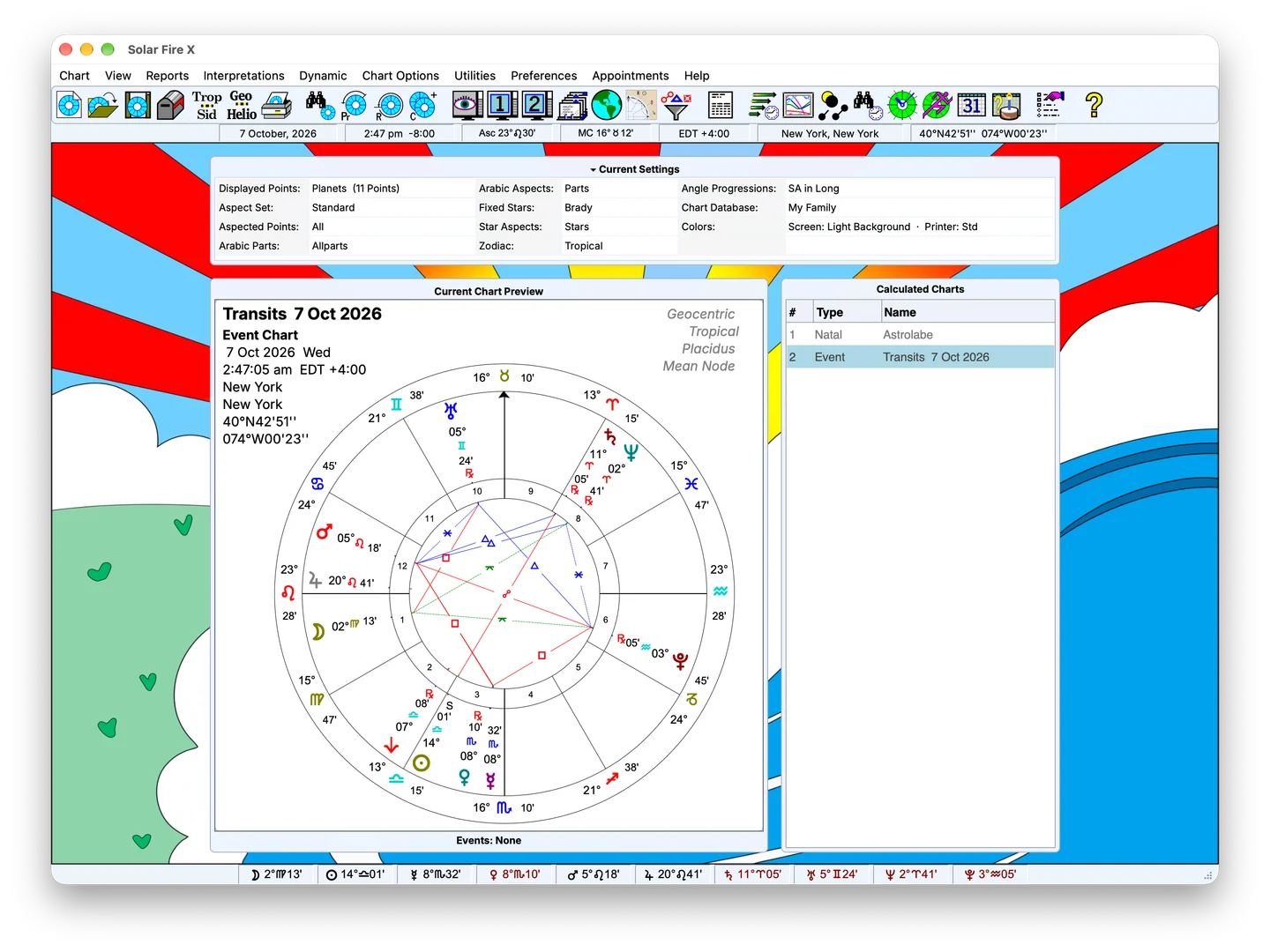
CHART OUTPUT: QUADRIWHEEL1 / 1 · PNG
Replace with a full-resolution exported wheel page. 1600×1600 PNG recommended.

In detail

What's inside

Build related charts

Different calculations answer different astrological questions. Explore progressions, directions and planetary returns, or compare relationship-chart approaches such as midpoint composite and Davison charts.

Harmonic and arc-transform calculations provide other ways to examine positions. Relocated charts let you consider the same event in the context of another place. Confirm the particular variant and settings your practice requires.

FIG. 02 · SCREENSHOT: PAGE DESIGNER8 / 5 · PNG
Sample Solar Fire X main screen with chart preview and calculated-chart list; feature-specific screenshot pending

Sample screen — feature-specific screenshot pending

Replace with a capture of the page layout editor. 1600×1000 PNG recommended.

Compare positions in one view

Use multiwheels to examine chart layers together, or a two-chart synastry grid to inspect contacts between charts. Choose a relevant point and aspect set so the comparison addresses the question being studied.

A natal chart and solar return, for example, can be compared with each layer identified and the chosen aspects visible.

FIG. 03 · SCREENSHOT: WHEELS AND MULTIWHEELS4 / 3 · PNG
Sample Solar Fire X main screen with chart preview and calculated-chart list; feature-specific screenshot pending

Sample screen — feature-specific screenshot pending

Feature-specific screenshot pending; sample main screen shown for layout review.

Configure the presentation

Wheel Designer lets you work on the chart's rings, glyphs, placement and style. Page Designer lets you arrange wheels, grids and tables into a reusable layout.

The calculation and its presentation serve different purposes: first establish the chart, then choose how to make its material readable for study or a consultation.

FIG. 04 · SCREENSHOT: POINTS AND ASPECTS WITHOUT ARBITRARY LIMITS4 / 3 · PNG
Sample Solar Fire X main screen with chart preview and calculated-chart list; feature-specific screenshot pending

Sample screen — feature-specific screenshot pending

Feature-specific screenshot pending; sample main screen shown for layout review.

Before choosing a specialist workflow

Coverage of a particular house system, chart type, body or transfer format needs release-specific confirmation. Included data collections, atlas coverage and migration paths are separate questions from the presence of a calculation tool.

Keep exploring

Related capabilities

Next step

See purchase options for Solar Fire X.

Solar Fire X is one complete instrument — every capability on this page ships in the same program.

Ordering opens Astrolabe's Cart32 catalogue — external site, alabe.com